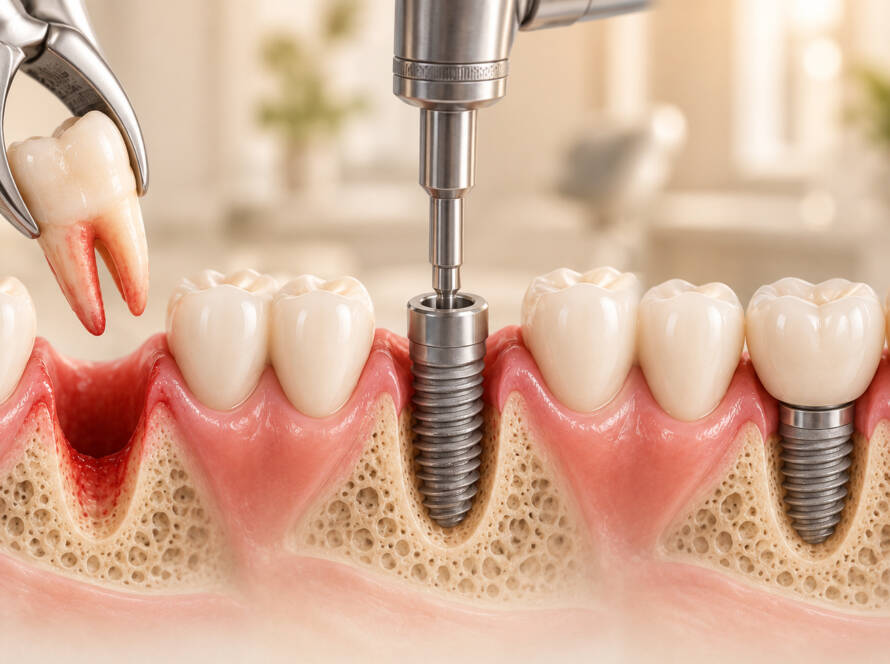
A dental bridge and a dental implant can both replace a missing tooth, but they rely on different types of support. A conventional tooth-supported bridge uses neighbouring teeth, while a single-tooth implant is placed in the jawbone and supports an implant crown without using adjacent natural teeth as bridge abutments.
Neither option is universally better. The condition of the teeth next to the gap, the amount and quality of bone and gum tissue, general health, bite, oral hygiene, surgical considerations and the wider restorative plan all influence the decision.
The most useful comparison is therefore not simply which option is faster or lasts longer, but which one fits the biology and restorative needs of the individual mouth.

How the Two Treatments Differ
A conventional bridge replaces a missing tooth with a prosthetic tooth connected to restorations on suitable supporting teeth. Those abutment teeth become part of the prosthetic system.
A dental implant is a fixture placed in the jawbone. After appropriate healing and prosthetic planning, it can support a crown that replaces the missing tooth.
The bridge approach depends heavily on the suitability of neighbouring teeth. Implant treatment depends on surgical suitability, bone and soft-tissue conditions and the ability to maintain healthy peri-implant tissues.
The Condition of Neighbouring Teeth
The teeth beside the gap can strongly influence the choice. A conventional bridge generally requires the supporting teeth to be prepared to receive the restorations that hold the bridge, so their structural and periodontal prognosis matters.
If the neighbouring teeth already contain large restorations or crowns, using them as bridge abutments may fit the wider treatment plan differently from using untouched teeth. This is why it is too simplistic to say that a bridge always “damages healthy teeth”; the starting condition of those teeth has to be considered.
For an otherwise healthy single-tooth space, an implant may preserve the adjacent teeth by avoiding conventional bridge preparation, but that benefit only matters if the implant site itself is suitable.
Bone, Gum Health and Implant Suitability
An implant has to be positioned in bone in a way that supports the planned final restoration. Bone volume, local anatomy, soft-tissue conditions, periodontal health and the prosthetic goal are assessed together.
Limited bone does not always exclude implant treatment. Selected cases may be considered for bone augmentation or another surgical approach. Gum health is equally important because active periodontal disease, poor plaque control, smoking and some medical conditions can increase risk and affect long-term maintenance.
The decision is therefore based on more than whether there appears to be enough space for an implant.
Surgery and Treatment Staging
Implant treatment includes a surgical component and may involve assessment, implant placement, healing and a later prosthetic phase. Extraction or bone augmentation can add further stages when clinically indicated.
A conventional bridge avoids implant surgery, but the supporting teeth may have their own restorative, endodontic or periodontal needs. For patients travelling for care, neither option should be assumed to require a fixed number of visits or days. The sequence depends on the condition of the teeth and tissues.
Cleaning, Bite and Long-Term Maintenance
Both bridges and implants require daily cleaning and professional review.
A bridge needs effective plaque control around the supporting teeth and beneath the replacement tooth. Those abutment teeth remain susceptible to decay, periodontal problems and structural complications.
An implant-supported crown requires plaque control around the implant restoration and healthy peri-implant tissues. Implants do not develop dental caries, but they are not immune to inflammatory disease or mechanical complications.
Bite also matters. Heavy loading, grinding or clenching can influence prosthetic design and mechanical risk for either option.
When a Dental Bridge May Fit the Plan
A conventional bridge may be considered when suitable supporting teeth are present and their structural and periodontal condition allows them to act as reliable abutments.
It can be particularly relevant when neighbouring teeth already need substantial restorative treatment, although this is not a rule. The design, cleanability and long-term prognosis of the support teeth should still be assessed carefully.
Avoiding surgery is one consideration, but it should not be the only reason to choose a bridge if the supporting teeth are unsuitable.
When a Dental Implant May Fit the Plan
An implant may be considered when the missing-tooth site has suitable surgical and prosthetic conditions and when the patient’s general health and risk profile support implant treatment.
For a single missing tooth, an implant can replace the tooth without using adjacent natural teeth as conventional bridge abutments. Even so, bone or soft-tissue augmentation, healing, periodontal risk, smoking, medical history and maintenance capacity can all affect suitability.
Longevity Is Individual, Not Guaranteed
There is no single lifespan that applies to every bridge or implant.
Bridges can develop problems involving supporting teeth, cementation, fracture or periodontal tissues. Implant treatment can involve peri-implant disease, loss of integration or mechanical problems with the implant-supported restoration.
Long-term performance depends on the supporting tissues, hygiene, bite, restoration design, habits, general health and professional maintenance. Population averages should not be converted into a personal guarantee.
When Neither Option Is Automatically Suitable
If an implant site has limited bone or surgical risk, that does not automatically make a bridge suitable; the proposed bridge still needs appropriate supporting teeth and a maintainable design.
Likewise, if a bridge is unsuitable because the neighbouring teeth are poor abutments, an implant is not automatically possible. The implant site, anatomy, periodontal condition and general health need separate assessment.
Sometimes both approaches are reasonable. Sometimes one is clearly preferable, and occasionally another prosthetic strategy is more appropriate.
Missing-Tooth Planning at Güler Dent
Dental Implant and Prosthetic Dentistry are main service areas at Güler Dent in Samsun, Turkey.
The clinic has in-clinic tomography technology for situations in which three-dimensional imaging is clinically indicated and its own prosthesis laboratory as part of its prosthetic infrastructure. Bone grafting and sinus-lift procedures may also be considered within oral-surgery planning when clinically indicated.
These resources support assessment and treatment planning, but they do not determine in advance whether a bridge or an implant is the right option for a particular missing tooth.