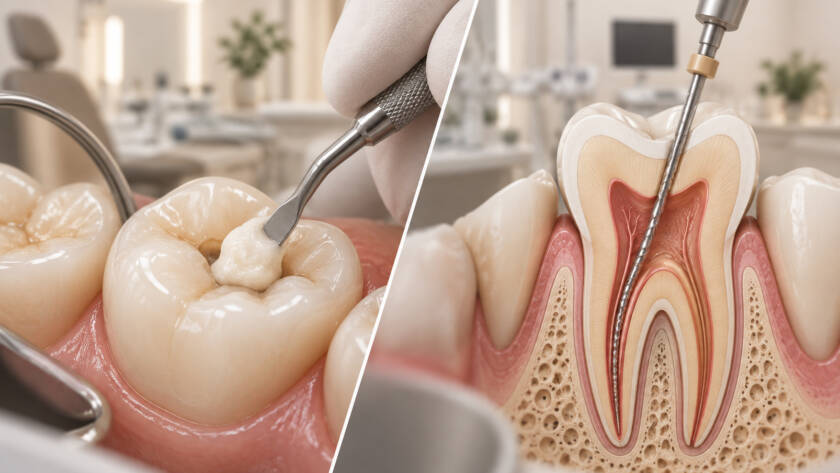
Temporary sensitivity to cold, heat, sweetness or pressure can occur after a dental filling, particularly when the original cavity was deep or the tooth was already irritated before treatment.
What matters clinically is how the symptom behaves. Brief sensitivity that is gradually becoming less noticeable can fit post-treatment recovery. A filling that feels clearly high when…
Dental fillings do not have a single fixed lifespan. Some remain functional for many years, while others need repair or replacement sooner because of recurrent decay, fracture, wear, heavy bite forces or changes in the surrounding tooth.
Age alone is not a reason to replace a filling. A restoration should be judged by its condition: whether…
Composite bonding uses tooth-coloured resin applied directly to selected tooth surfaces to repair or reshape small areas. It may be considered for minor chips, worn or uneven edges, small gaps and limited changes in tooth shape or proportion.
For patients researching composite bonding in Turkey, the main issue is whether composite is the right material and…
A composite filling is a tooth-coloured direct restoration used to repair selected areas of tooth structure lost through decay, fracture, wear or failure of an existing restoration. Because composite resin can be matched to the surrounding tooth and bonded to enamel and dentine, it can be used in both front and back teeth when the…
If you have a deep cavity, sensitivity or tooth pain, it is understandable to wonder whether a filling will be enough or whether you need root canal treatment. The decision is not based on cavity size alone. Dentists also look at the condition of the pulp inside the tooth, how much healthy tooth structure remains,…