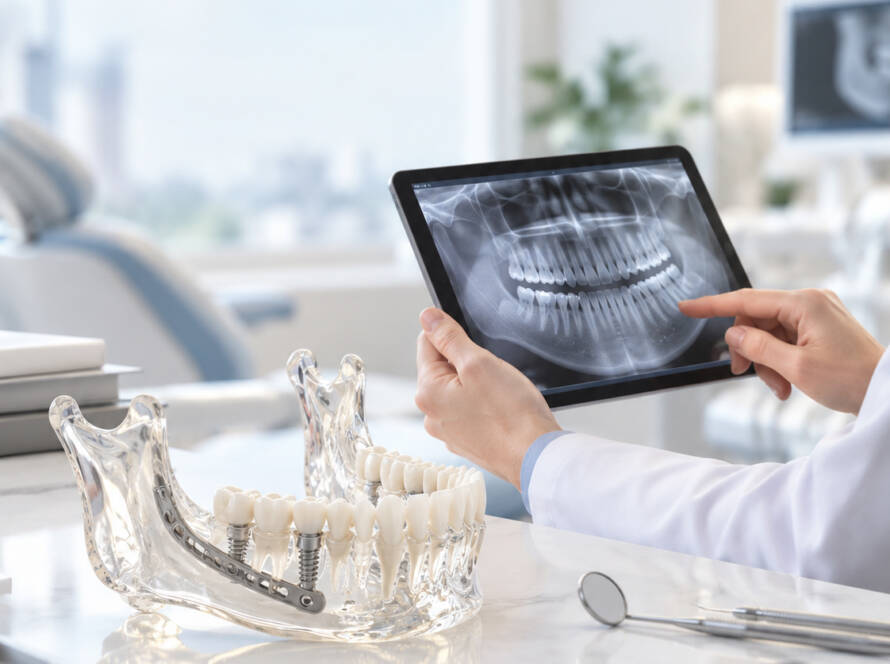
Dental Implants in Turkey
Dental implants can support the replacement of one missing tooth, several missing teeth or, in selected cases, a full arch of missing teeth. Implant treatment is not simply the placement of an implant into the jaw. A sound plan considers the condition of the gums and bone, general health and medications, the bite, the position of the missing teeth and the prosthetic restoration that the implants will ultimately support.
Contents
ToggleFor patients considering dental implant treatment in Turkey, the most important question is not whether an implant can be placed quickly, but whether implant treatment is appropriate for the individual case and whether the surgical and prosthetic stages can be planned together. Treatment may involve a single implant and crown, several implants supporting a bridge or other prosthesis, or an implant-supported full-arch restoration. Some patients may also need bone augmentation or sinus-related surgery, while others do not.
Güler Dent is a dental clinic in Atakum, Samsun, Turkey, founded in 2021 by Dr. Dt. Şevki Güler. The clinic has in-clinic tomography technology and its own prosthesis laboratory. These are clinical infrastructure features; they do not by themselves guarantee a particular outcome, treatment time or number of appointments. Güler Dent is also a HealthTürkiye member.
What Is a Dental Implant?
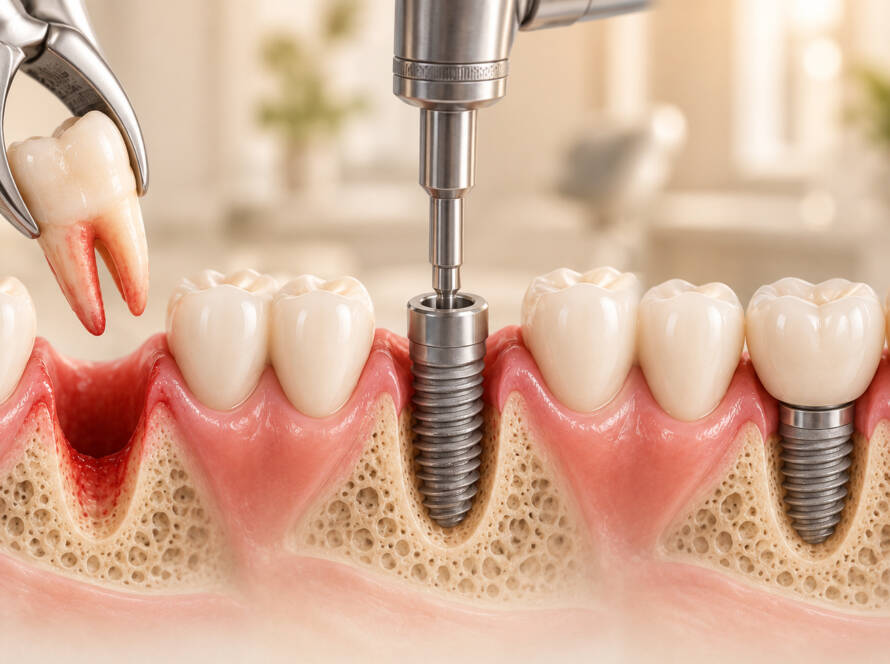
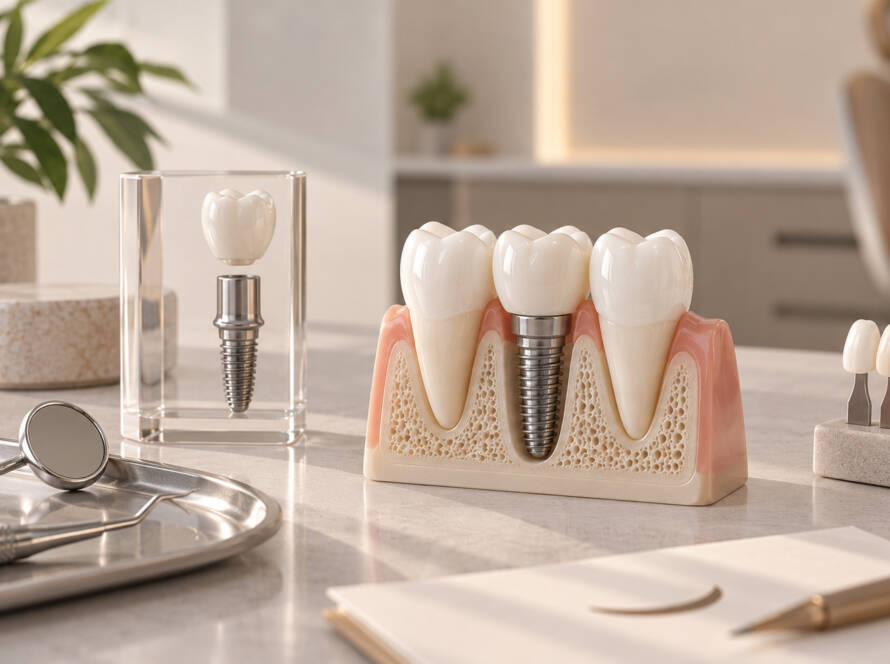
A dental implant is a component placed in the jawbone to support a dental restoration. Depending on the clinical situation, the restoration may replace a single tooth, several teeth or a complete dental arch.
Implant treatment therefore has both surgical and prosthetic dimensions. The implant must be positioned with the future restoration in mind, while the restoration must be designed around the number and distribution of implants, the bite, hygiene access and the condition of the surrounding tissues.
Who May Be Considered for Dental Implant Treatment?
Implants may be considered for people with a single missing tooth, multiple missing teeth or complete tooth loss. Suitability is not determined by age or the number of missing teeth alone.
Assessment may include general health, medications, gum health, oral hygiene, smoking, diabetes control, available bone and individual risk factors. Active periodontal disease or poor plaque control may need to be addressed as part of implant planning. Certain medical conditions and treatments can also change surgical risk and may require individual assessment or coordination with the patient’s medical team.
Having a risk factor does not automatically mean that implant treatment is impossible. The significance of each factor depends on the person’s health and dental findings.
Some medical histories need particular attention before implant surgery. Poorly controlled diabetes can increase healing and complication risk. Certain medicines that affect bone metabolism, including antiresorptive drugs used in some osteoporosis or cancer treatments, and a history of radiotherapy to the head and neck can also change surgical risk. These situations require individual assessment and, where appropriate, coordination with the patient’s medical team rather than an automatic decision for or against implant treatment.
Implant Options for Different Types of Tooth Loss
Replacing a Single Tooth
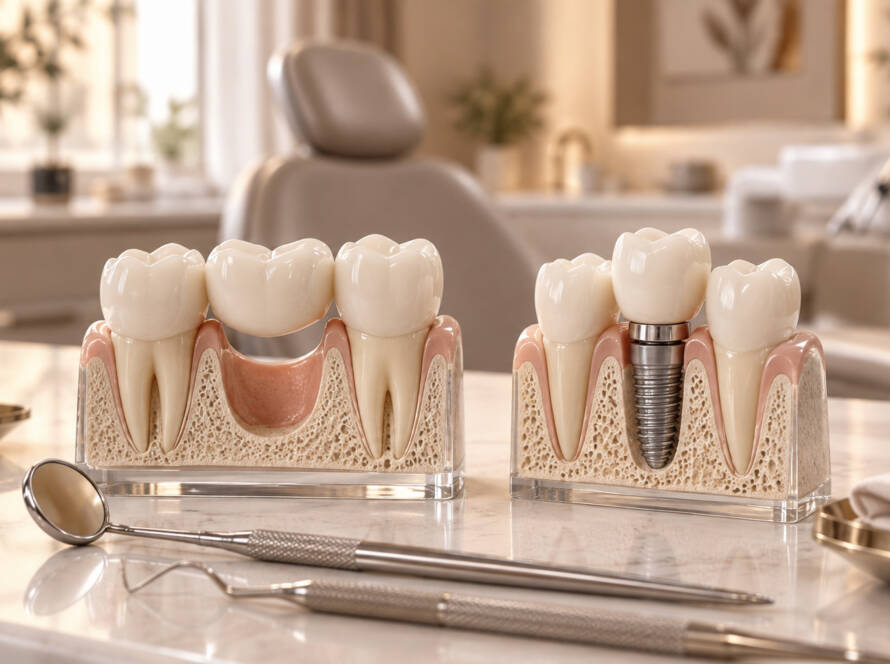
A single implant with an implant-supported crown may be considered when one tooth is missing and the local bone, soft tissues and overall treatment plan are suitable. Unlike a conventional tooth-supported bridge, this approach does not require the neighbouring teeth to serve as bridge abutments, although it introduces surgical, bone and soft-tissue considerations that a bridge does not. Planning includes the implant position, space for the future crown, bite, hygiene access and the condition of the neighbouring teeth.
Replacing Several Teeth
When several teeth are missing, the number of implants does not necessarily have to match the number of missing teeth. Implant position, bone conditions, the length of the space and the design of the planned prosthesis all influence the plan. In suitable cases, several missing teeth may be replaced with an implant-supported bridge rather than one implant for every missing tooth. Whether this is appropriate depends on the span being restored, the distribution of available bone, the planned implant positions, bite forces, hygiene access and the prosthetic design. The decision is therefore made from the final restoration backwards, not from tooth count alone.
Full-Arch Implant-Supported Teeth
For complete tooth loss, fixed or removable implant-supported prosthetic options may be considered. A fixed full-arch restoration is not routinely removed by the patient and depends on an implant distribution and prosthetic design that can support function while still allowing hygiene. A removable implant-supported prosthesis can use implants to improve support or retention but remains removable for cleaning. These are different prosthetic solutions rather than interchangeable package names. In selected full-arch cases, a fixed full-arch prosthesis may be planned on four to six appropriately distributed implants. This is not a universal implant count or a guaranteed protocol. Bone volume and quality, anatomical limitations, implant distribution, the opposing dentition, bite, prosthetic design and maintenance access can all affect the number and position of implants.
You may hear terms such as “All-on-4” or “All-on-6” when exploring full-arch treatment. These describe approaches involving different implant numbers, but the right number and position of implants depend on your bone, bite and planned replacement teeth.
How Is Implant Treatment Planned?
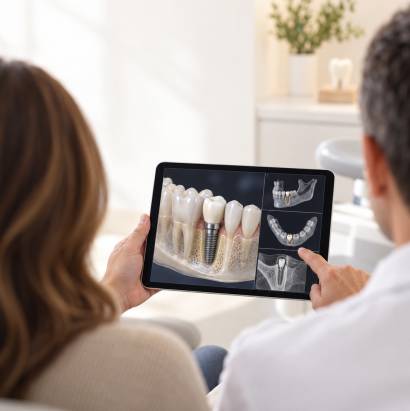
Planning begins with the teeth, gums, bone, bite and intended final restoration. Clinical examination and appropriate dental imaging help determine whether an implant can be placed in a prosthetically suitable position and whether additional procedures may be needed.
Three-dimensional imaging can be useful when clinically indicated for evaluating implant sites and nearby anatomical structures. Güler Dent has in-clinic tomography technology. The need for a particular imaging examination is determined by the clinical question rather than by using the same scan for every patient.
The surgical and prosthetic plan should be considered together. Implant number and position, possible tooth extraction, bone augmentation needs and the intended implant-supported restoration are interconnected decisions.

What Are the Main Stages of Implant Treatment?
Implant treatment commonly involves assessment and planning, surgical implant placement, a healing phase and the prosthetic phase. The exact sequence varies.
In selected cases, an implant may be placed at the same appointment as a tooth extraction if the local bone and soft-tissue conditions, infection status, implant position and primary stability allow it. This is not suitable after every extraction.
After placement, biological healing between the implant and bone is required. The timing of the prosthetic stage depends on the clinical situation. “Implant placed today” does not automatically mean that a definitive tooth is completed on the same day.
What If There Is Not Enough Bone?
Limited bone does not automatically rule out implant treatment. The amount and shape of the available bone, local anatomy and the planned prosthesis are assessed together.
Bone grafting or other augmentation procedures may be considered in selected cases. In the back of the upper jaw, a sinus lift may be considered when the relationship between the sinus and available bone affects implant planning. Some augmentation procedures may be combined with implant placement, while others may require a staged approach.
These procedures are not required for every implant patient and do not guarantee a particular implant outcome.
Evaluating Dental Implant Treatment in Turkey
A safe decision is based on the quality and completeness of the treatment plan, not on destination or price alone. Before accepting implant treatment, a patient should understand which teeth are being replaced, why the proposed implant number and positions are appropriate, what type of final restoration is planned, whether additional procedures are expected and what the main surgical and prosthetic risks are.
Claims such as “same-day teeth,” a fixed implant count or a lifetime result should not replace case-specific assessment. Where a full-arch or complex plan is proposed, the surgical and prosthetic parts should make sense together and allow for hygiene and long-term maintenance.
Risks and Long-Term Maintenance
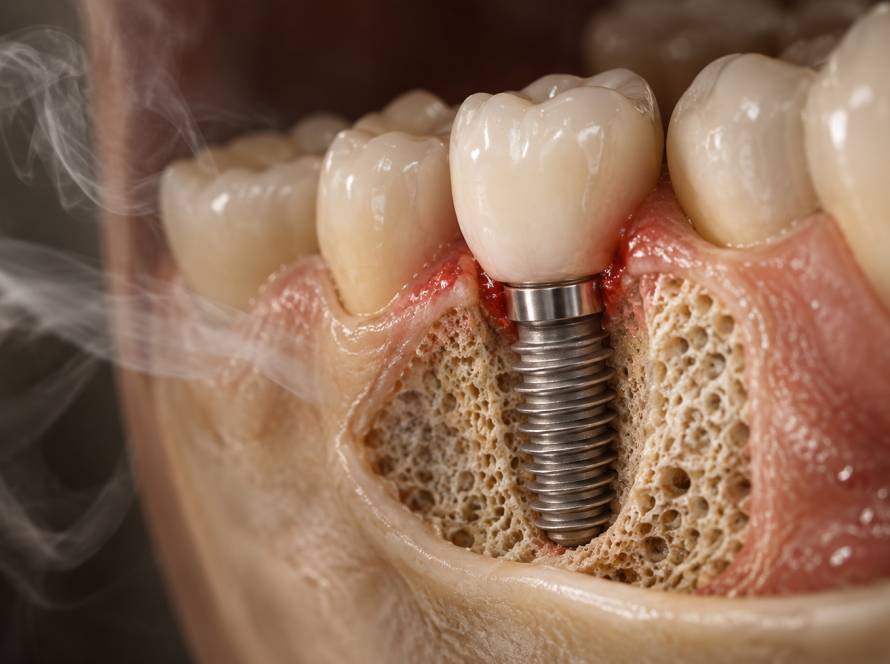
Implant treatment has surgical and prosthetic risks. Possible problems can include infection, failure of the implant to integrate as expected, soft-tissue or healing complications and, in anatomically sensitive areas, complications involving nearby structures. Over time, inflammatory disease can affect tissues around implants, and mechanical problems can occur with implant-supported restorations.
Peri-implant mucositis affects the soft tissues around an implant, while peri-implantitis also involves loss of supporting bone. Plaque control, smoking, diabetes and a history of periodontitis can be relevant to risk assessment.
Long-term care includes daily cleaning appropriate to the restoration and periodic professional review. Completing the prosthesis does not end the need for maintenance.
Early Healing After Implant Surgery
The first stage of healing is influenced by the extent of surgery and the patient’s individual response. Temporary tenderness, swelling or discomfort can occur after implant placement, and the expected pattern may be different if an extraction, grafting or sinus-related procedure was carried out at the same time. The surgical area should be protected and oral-hygiene and eating instructions should be followed as advised for the specific procedure.
Symptoms that become more severe rather than settling, persistent bleeding, discharge, increasing swelling or other unexpected changes should be assessed. Early healing advice is therefore part of the surgical plan, not a generic set of instructions that is identical for every implant patient.
What Affects Long-Term Implant Performance?
There is no fixed lifespan or lifetime guarantee for a dental implant. Long-term performance depends on several interacting factors, including plaque control, the health of the tissues around the implant, smoking, general health, the position of the implant, bite forces and the design and cleanability of the implant-supported restoration.
The implant, the surrounding tissues and the prosthesis all need continuing care. A technically completed restoration does not remove the need for maintenance, and changes in the prosthesis or peri-implant tissues may require review, repair or further treatment over time.
After Returning Home: What Still Needs Attention?
Long-term implant care continues wherever the patient lives. Routine oral hygiene and professional review remain important, and the implant-supported restoration as well as the surrounding tissues may need assessment over time.
New or increasing pain, swelling, discharge, persistent bleeding around an implant, a feeling that the restoration is loose, or other unexpected changes should be clinically assessed rather than managed only by waiting for a future trip. Urgent symptoms such as uncontrolled bleeding, rapidly progressive swelling or difficulty swallowing or breathing require prompt local medical or dental evaluation.
How Long Does Dental Implant Treatment Take?
There is no single treatment duration that applies to every patient. Tooth extraction, implant number and position, bone and soft-tissue conditions, healing response, additional surgery and the prosthetic design can all change the overall timeline.
A treatment schedule should therefore be based on the clinical plan rather than on a fixed number of days advertised for all patients.
Treatment Stages and Travel Planning
Implant treatment may require more than one clinical stage because surgical placement, biological healing and the definitive prosthetic phase are different parts of care. Extraction, grafting, sinus-related surgery, implant stability and the type of final restoration can change whether stages are combined or separated.
For someone travelling for treatment, the practical schedule should therefore be built around the clinical sequence rather than a universal number of trips or days. Before making travel arrangements, it is reasonable to understand which stage is expected to occur at each appointment, whether healing must be assessed before the next stage and what would cause the plan to change.
What Affects the Cost of Dental Implant Treatment?
The total cost can depend on the number and position of implants, the implant-supported restoration, the need for extraction or preliminary treatment, and any required bone or soft-tissue procedures. Several missing teeth do not always require the same number of implants as missing teeth.
A meaningful quotation should reflect the actual treatment plan rather than only a headline “price per implant.”
Comparing Dental Implant Quotes
When comparing implant treatment plans, ask what the quoted price includes. Check how many implants are proposed, what type of replacement teeth they will support, and whether tooth extractions, bone grafting, imaging, temporary restorations or later prosthetic appointments are included.
Two quotes may cover different stages of care. For example, one may include only implant placement, while another also includes the final teeth or additional surgery. Ask for a clear explanation of the proposed stages and what is included before comparing the total cost.
Dental Implant Care at Güler Dent
Güler Dent approaches implant treatment as part of overall oral health planning. The clinic’s in-clinic tomography technology can support imaging when clinically indicated, while its own prosthesis laboratory is part of its prosthetic infrastructure.
Dr. Dt. Şevki Güler graduated from Samsun 19 Mayıs University Faculty of Dentistry and previously served as Head of the Department of Periodontology at Bolu Abant İzzet Baysal University Faculty of Dentistry.
Smiles Shaped by Science, Experience, and Trust
Frequently Asked Questions
Can everyone have dental implants?
No. Suitability depends on oral health, bone and gum conditions, medical history, medications and individual risk factors.
Can an implant be placed immediately after extraction?
Sometimes. Bone and soft-tissue conditions, infection, implant position and primary stability must be assessed.
Is bone grafting always required?
No. It is considered only when the available bone and treatment plan indicate a need for augmentation.
Can people with a history of gum disease have implants?
Implant treatment may be considered after periodontal health has been assessed and managed. A history of periodontitis can remain relevant to long-term maintenance and risk.
How many implants are needed for a full arch?
There is no universal number. In selected cases, four to six implants may support a fixed full-arch prosthesis, but the number and distribution are individualized.
Do implants last for life?
A lifetime guarantee cannot be made. Long-term outcomes depend on peri-implant health, hygiene, maintenance, smoking, general health and prosthetic factors.
Records and Long-Term Implant Maintenance When Living Abroad
Before travelling, ask what medical history, current dental records and previous radiographs the treating team would need to review; any discussion before an in-person examination is preliminary. For long-term care abroad, patients should also ask how to obtain their treatment records and details of the implant components used, as these may be important if future maintenance or prosthetic repairs are needed. Availability and handover arrangements should be confirmed with the clinic rather than assumed.
Dental Implant Consultation in Samsun, Turkey
If you are considering dental implants in Turkey, a consultation should establish whether implant treatment is suitable, what surgical and prosthetic stages may be required, and whether procedures such as extraction, bone grafting or sinus lifting need to form part of the plan. The sequence and number of appointments are determined by the individual clinical findings rather than a standard travel package. To arrange an implant assessment with Güler Dent Ağız ve Diş Sağlığı Polikliniği, contact the clinic at the details below.
- Address: Mimarsinan Mahallesi, Atatürk Boulevard, No: 266, Atakum, Samsun, Turkey
- Phone: +90 552 439 00 01
Diagnosis and treatment planning are based on an individual clinical assessment.
This page provides general information and does not replace an individual dental examination or treatment plan.