


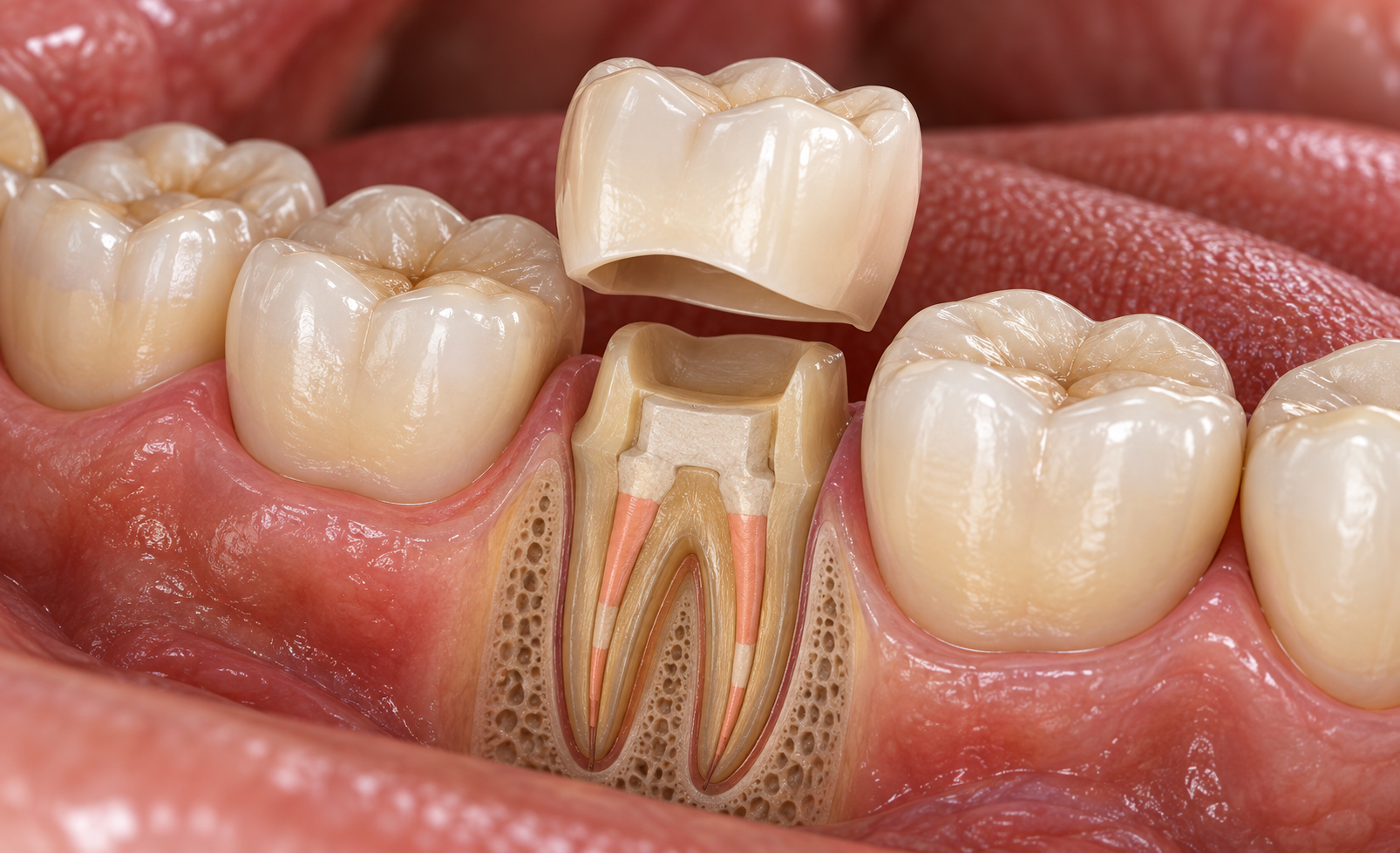
Not every tooth that has root canal treatment automatically needs a full crown. The final restoration depends on how much healthy tooth structure remains, which tooth was treated, whether the cusps are intact, whether a crack is present, how strong the bite forces are and whether the tooth can be restored predictably.
Back teeth, especially molars and premolars with significant structural loss, often benefit from cuspal coverage. In selected teeth with substantial remaining structure, a direct filling or partial-coverage restoration such as an onlay may be appropriate.
The restorative decision should therefore be based on the condition of the tooth after endodontic treatment rather than on the fact that a root canal was performed.
Remaining Tooth Structure Drives the Decision
Teeth reach root canal treatment with very different amounts of sound tissue. One tooth may have a small access cavity and otherwise strong walls, while another may already have a large cavity, a substantial old filling, missing cusps, a fracture or extensive wear.
The amount and distribution of remaining structure strongly influence fracture risk and the type of restoration required.
Root canal treatment is only one part of the tooth’s mechanical history.
Why Posterior Teeth Often Need Cuspal Coverage
Molars and premolars carry substantial chewing forces. When large amounts of central tooth structure are missing, their cusps can become more vulnerable to flexure and fracture.
Cuspal coverage can help distribute those forces across the remaining tooth. This does not always mean a traditional full crown. Depending on the clinical situation, an onlay, overlay or another partial-coverage restoration may provide protection while preserving more healthy tissue.
When a Direct Filling May Be Sufficient
A direct restoration can be appropriate when substantial healthy tooth structure remains, the cusps are intact, the access cavity is limited, no major crack is present and bite forces are favourable.
This is more likely in some anterior teeth and selected teeth with relatively limited structural damage.
The decision is based on structure and function rather than a blanket rule that every root-treated tooth needs full coverage.
When a Full Crown Becomes More Relevant
A crown may be considered when there is extensive structural loss, weakened or missing cusps, a large existing restoration, significant fracture risk or functional demands that exceed what a direct restoration can predictably support.
Because a crown requires more tooth preparation than a filling or many onlay designs, the indication should be justified by the structural need.
Onlays and Overlays
Onlays and overlays are indirect restorations that can cover one or more cusps without necessarily covering the entire tooth in the way a full crown does.
Current systematic reviews suggest that full cuspal-coverage onlays can perform well in appropriately selected endodontically treated posterior teeth.
Suitability depends on remaining walls, cusp thickness, margin location, bite, available enamel for bonding, crack pattern and restorative material. They are not automatically better than crowns, but they can offer a more conservative option for selected teeth.
Front Teeth After Root Canal Treatment
Anterior teeth have different loading patterns from molars and premolars.
If a front tooth retains substantial healthy structure and has only limited access or restorative loss, a bonded direct restoration may be adequate. A crown or another indirect restoration becomes more relevant when there is major structural loss, fracture, extensive previous restoration, severe discolouration requiring restorative management, unfavourable loading or other prosthetic needs.
Tooth position alone does not determine the restoration.
Ferrule and Structural Support
When a crown is planned, the amount and continuity of sound tooth structure above the finish line can influence resistance to functional forces. This band of remaining structure is commonly described as a ferrule.
The ferrule effect is one reason remaining tooth tissue matters so much. It is not simply the presence of a post or the fact that a root canal has been performed that protects the tooth from fracture.
Posts and Cores
A post is not placed routinely in every root-treated tooth.
Its principal role is to help retain a core when there is not enough coronal tooth structure to hold the restoration. A post should not be described as something that simply “strengthens” the root.
Post placement requires space within the root canal and can introduce additional procedural risks, so the need is determined by remaining tooth structure and the planned restoration.
The Importance of the Coronal Seal
Root canal treatment cleans and seals the internal canal system, but the tooth also needs an effective restoration above the gumline.
A damaged, leaking or lost temporary or final restoration can allow new contamination and leave the tooth mechanically vulnerable. Completing the appropriate definitive restoration is therefore an important part of the overall treatment.
The type of restoration remains case-specific.
Cracked Teeth and Restorability
A crack can change the restorative plan significantly. Some cracks can be managed with an appropriate restoration, while others extend too deeply or unfavourably and make the tooth non-restorable.
Assessment can include crack location and depth, periodontal probing, symptoms, remaining tooth structure and radiographic findings.
A crown cannot rescue every cracked root-treated tooth.
Timing of the Definitive Restoration
The tooth should be protected and definitively restored within an appropriate clinical time frame, but there is no one universal deadline for every case.
Timing depends on whether endodontic treatment is complete, the symptom pattern, the quality of the temporary restoration, structural risk, any need for reassessment and the final restorative plan.
A heavily weakened tooth should not be left unprotected simply because it feels comfortable.
Restoration Planning at Güler Dent
Endodontics, Restorative Dentistry and Prosthetic Dentistry are main clinical service areas at Güler Dent in Samsun, Turkey.
After root canal treatment, assessment can consider remaining tooth structure, tooth position, bite and restorative needs. Endodontics Specialist Uzm. Dt. Buğra Güler takes part in assessment in this field.
Güler Dent also has its own prosthesis laboratory as part of its prosthetic infrastructure. This does not mean every root-treated tooth requires a crown or that every crown follows the same production time.

