A composite filling is a tooth-coloured direct restoration used to repair selected areas of tooth structure lost through decay, fracture, wear or failure of an existing restoration. Because composite resin can be matched to the surrounding tooth and bonded to enamel and dentine, it can be used in both front and back teeth when the clinical conditions are suitable.
For patients researching composite fillings in Turkey, the relevant question is not simply whether a white material is available. The size and location of the defect, the amount of healthy tooth structure that remains, the condition of the pulp, the bite and the ability to place the material under suitable conditions all affect whether direct composite is the right treatment.
What Composite Fillings Are Designed to Do
Composite resin is a tooth-coloured restorative material made from a resin matrix combined with inorganic filler particles. During treatment, the tooth surface is prepared for bonding, the composite is placed and shaped, and the material is hardened with a curing light before being adjusted and polished.
Although composite is often called a “white filling”, its role is not purely cosmetic. It is a restorative material used to rebuild lost tooth structure and return the tooth to function.
When Composite May Be Appropriate
Composite fillings can be considered for cavities that require direct restoration, limited fractures or chips, selected areas of tooth wear, replacement or repair of a defective existing restoration and other small-to-moderate defects in front or back teeth.
Suitability depends on the defect rather than on the material requested. A modest lesion that can be isolated and restored directly is very different from a heavily broken tooth with limited remaining structure.
Composite in Front Teeth
Composite is commonly used in anterior teeth because it can be colour-matched and shaped directly. In this area, the dentist considers not only the size of the defect but also tooth form, symmetry, the amount of enamel available, incisal loading, neighbouring teeth and gum health.
A front-tooth composite can therefore serve a restorative purpose, an aesthetic purpose or both.
Composite in Back Teeth
Posterior teeth carry greater chewing forces, so restoration size, tooth position and remaining tooth structure become particularly important.
Composite is widely used in back teeth, but a very large defect, a crack or substantial loss of cuspal structure may be better managed with an indirect restoration or another approach. There is no useful rule that composite should always or never be used in molars; the clinical situation determines suitability.
Not Every Caries Lesion Needs a Filling
Dental caries exists on a spectrum. Some early non-cavitated lesions can be managed with preventive and non-operative approaches when lesion stage, activity and patient risk support that strategy.
Once structural breakdown is present, restorative treatment may be required. The decision depends on whether the surface is cavitated, lesion depth and location, caries activity, cleanability, overall caries risk, pulp status and whether the tooth remains restorable.
A diagnosis of caries does not automatically mean that every lesion must be drilled and filled.
When a Direct Filling May Not Be Enough
A direct composite may not be the correct endpoint when too much tooth structure has been lost or when another biological problem is present.
Deep decay can affect the pulp. A tooth may contain a significant crack, an old restoration may conceal a wider structural problem, or there may be too little remaining structure for a direct restoration to function predictably. In such situations, endodontic treatment, an onlay, a crown or another restorative approach may need to be considered.
The treatment decision should therefore be based on the whole tooth, not simply on the visible size or colour of the cavity.
Composite Fillings and Cosmetic Bonding
Both treatments can use composite resin, but their purpose is often different.
A composite filling primarily replaces tooth tissue lost through decay, fracture or another structural defect. Composite bonding, in patient-facing cosmetic dentistry, often refers to adding resin to change aspects of shape, edge length or spacing.
The techniques overlap, particularly in front teeth, but a tooth with active decay should not be approached as a purely cosmetic bonding case.
How a Composite Filling Is Placed
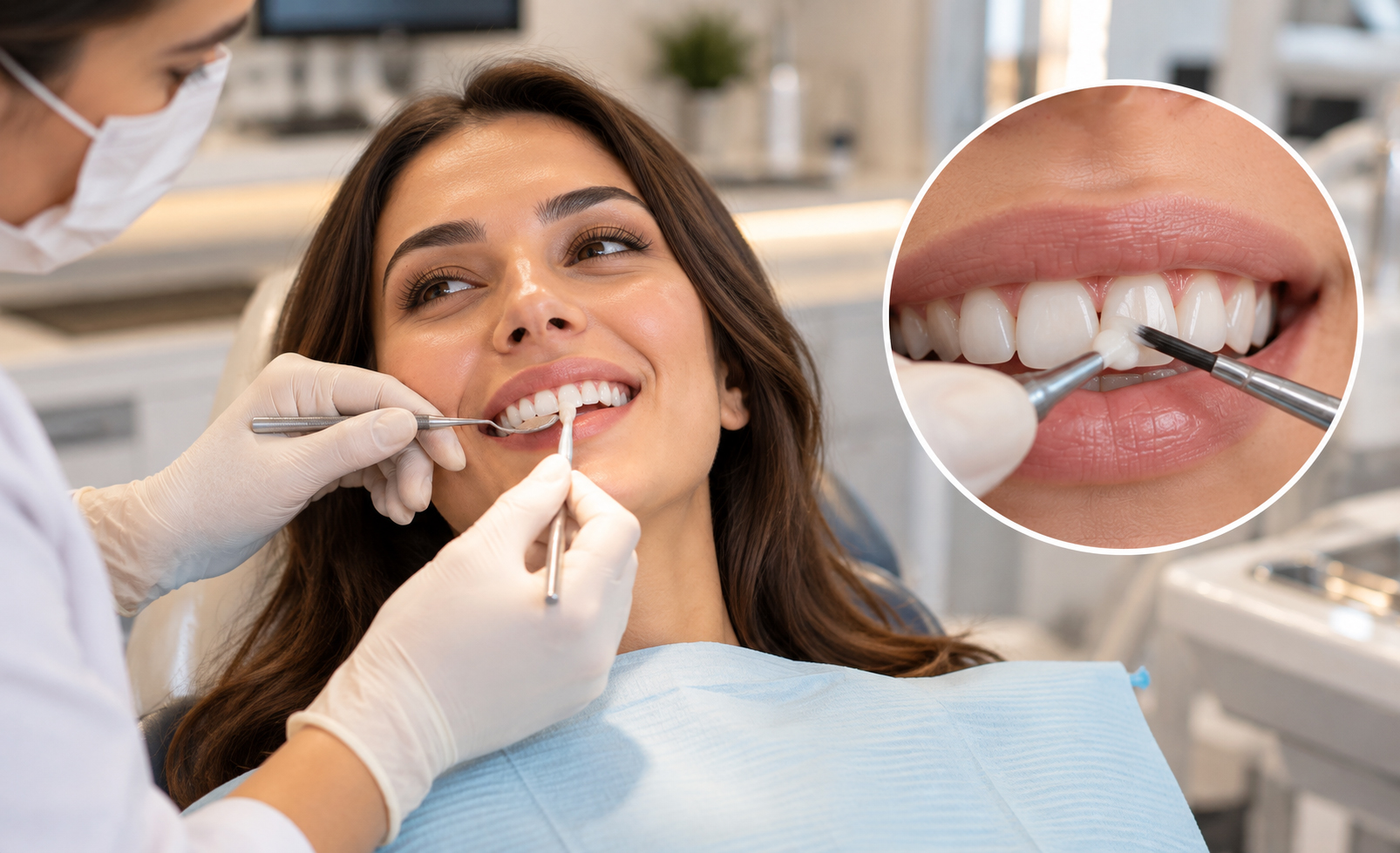
The exact sequence varies according to the tooth and defect, but treatment generally involves assessing whether direct composite is appropriate, managing diseased or damaged tissue as needed, isolating the area, preparing the surface for adhesive bonding, placing and shaping the material, curing it, and then finishing and polishing the restoration before checking the bite and contact with neighbouring teeth.
Local anaesthesia may be used when appropriate. The procedure is adapted to the clinical situation rather than following one identical protocol for every filling.
Sensitivity After Treatment
Temporary sensitivity can occur after restorative treatment, especially when the original lesion was deep. Brief symptoms that settle are different from spontaneous pain, increasing pain, marked biting pain or sensitivity that persists.
Possible causes include pulpal irritation, the depth of the original lesion, a bite that needs adjustment, a crack or another problem. Persistent or worsening symptoms should be reassessed rather than assumed to be a normal part of recovery.
Wear, Staining and Repair
Composite restorations can change over time. Depending on location and use, they may develop surface staining, wear, marginal changes, chipping, fracture or recurrent caries.
A cosmetic colour change does not automatically mean that a restoration needs complete replacement. Clinical assessment can determine whether polishing, repair, partial replacement or full replacement is appropriate.
Replacing an Old Filling
Age alone is not a diagnosis. An old filling does not need to be replaced simply because a certain number of years has passed.
Intervention may become appropriate when there is recurrent caries, fracture, loss of marginal integrity, a broken or missing portion, symptoms related to the tooth or a structural problem that makes repair insufficient.
Where clinically suitable, repair can sometimes preserve more healthy tooth structure than complete replacement.
Restorative Care at Güler Dent
Restorative Dentistry is one of the main clinical service areas at Güler Dent in Samsun, Turkey. Composite restorations can be considered for decay, fractures and selected losses of tooth structure when direct treatment is appropriate.
Aesthetic composite filling and bonding can also be considered within smile-related planning, but the choice depends on whether the main problem is structural, biological or aesthetic.