


Dental implant prices in Turkey are often presented as a single number, but a headline figure can be misleading if it does not explain what is included. One quotation may refer only to the implant fixture, while another may include the abutment and final crown. A full-arch quotation may include several implants and a fixed prosthesis, while another may cover only the surgical stage.
The total scope can also change when extractions, bone grafting, sinus augmentation, additional imaging, temporary restorations or a different prosthetic design are needed.
A useful comparison therefore looks at like-for-like treatment plans rather than asking only “How much is one implant?”. The number of implants, the final restoration and any additional procedures all need to be understood before two quotations can be compared meaningfully.
Why Implant Quotations Differ
Dental implant treatment is a surgical and prosthetic pathway rather than a single product. Cost can change according to how many teeth are missing, how many implants are actually planned, whether the case involves one tooth or a full arch, the implant components used, the type of crown or prosthesis, and whether preparatory or additional procedures are required.
The condition of the gums and remaining teeth also matters. A patient who needs periodontal treatment, extractions or bone augmentation has a different treatment scope from someone with a straightforward single-tooth space.
Two quotations can therefore look very different while both are described online as “dental implants in Turkey”.
Understanding What an Implant Quote Includes
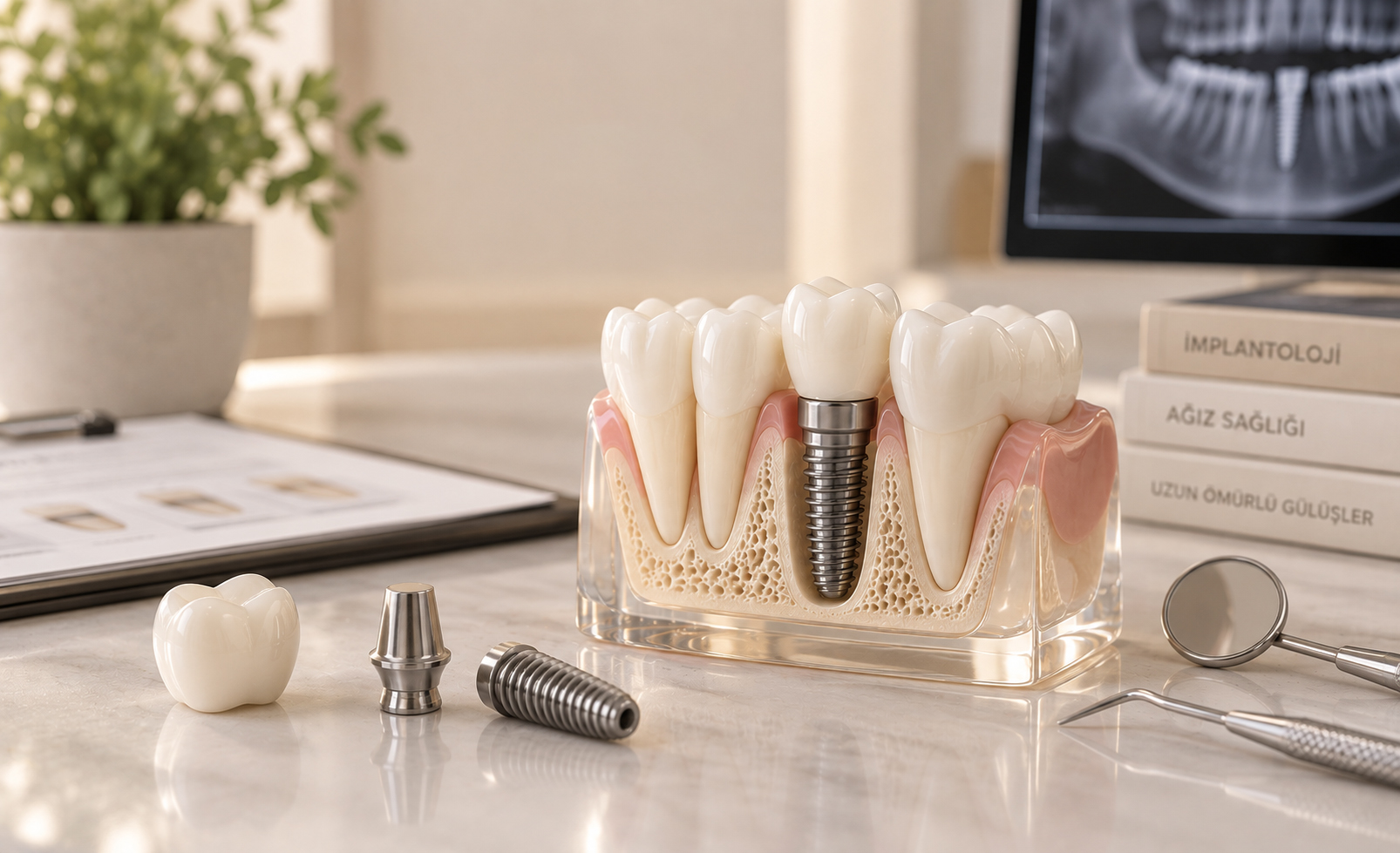
A dental implant restoration usually involves more than the implant fixture itself.
The fixture is placed in the jawbone and acts as the foundation. Depending on the implant system and prosthetic design, an abutment or other connection component links the implant to the restoration. The visible tooth replacement is a separate prosthetic stage: a crown for a single tooth, or a different design for multi-unit or full-arch treatment.
A quotation that lists only an “implant” may therefore not represent the complete treatment needed to replace a missing tooth. Patients should check whether the final restoration is included and what type of restoration is planned.
The Number of Missing Teeth Does Not Equal the Number of Implants
A single missing tooth can often be replaced with one implant and one crown when the site and patient are suitable, but several adjacent missing teeth do not always require one implant for every missing tooth. In selected cases, an implant-supported bridge can replace more than one tooth.
For a fully edentulous arch, implant number and distribution are determined by bone, anatomy, prosthetic design, bite and other clinical factors. Simply multiplying a “per implant” price by the number of missing teeth can therefore produce an inaccurate estimate.
Why Full-Arch Treatment Has a Different Cost Structure
Full-arch treatment is a different surgical and prosthetic problem from a single implant crown.
The quotation may need to account for multiple implants, treatment planning across the entire arch, extractions where necessary, temporary prosthetic stages in selected cases, a full-arch final prosthesis, bite and jaw-relation records, laboratory work and long-term maintenance requirements.
Different full-arch concepts can use different implant distributions and prosthetic designs. A branded treatment label by itself does not show that two plans are clinically equivalent.
Bone Grafting and Sinus Augmentation
Some implant sites already have suitable bone, while others have insufficient width, height or anatomy for the intended implant position. In selected cases, bone grafting or sinus augmentation may be considered.
These procedures add a separate surgical component and can affect the materials, treatment stages and overall scope. They are not required for every implant patient and should not be included automatically without a clinical indication.
Imaging and Diagnostic Planning
Imaging is selected according to the clinical question. A panoramic radiograph can provide a broad overview, while CBCT can add three-dimensional information when bone dimensions or anatomical relationships need cross-sectional assessment.
Güler Dent has in-clinic tomography technology, but that does not mean every implant case automatically receives CBCT. When comparing quotations, it is useful to understand what imaging is clinically required and whether it is included in the treatment scope.
Temporary Restorations and Provisional Stages
Some implant plans include a temporary restoration during healing or while definitive prosthetic work is being completed. Other cases may not require one.
The type, material and purpose of a provisional restoration differ greatly between a single implant and a full-arch case. If a quotation refers to “temporary teeth”, the details should be clear: what restoration is being provided, when it is used and what role it has in the treatment plan.
Implant Brand Is Only One Cost Variable
Implant systems can differ in component availability, restorative options and price. Brand can therefore influence a quotation, but it does not determine whether the treatment plan is appropriate.
Diagnosis, implant position, bone and gum health, prosthetic design, plaque control and long-term maintenance remain important regardless of the brand. A higher-priced implant system cannot compensate for an unsuitable plan, and a lower-priced system cannot be judged purely by cost without understanding the clinical context.
How to Compare Dental Implant Quotations
A useful written quotation should make the treatment scope understandable. Patients should be able to see how many implants are planned, whether the final crown or prosthesis is included, whether extractions or grafting are expected, what imaging is required and whether temporary restorations form part of the plan.
It is also important to understand whether existing teeth need treatment before or alongside the implants and which parts of the quotation are surgical versus prosthetic.
The goal is not the longest quotation. It is a transparent description of the treatment needed to address the same clinical problem.
Price Alone Does Not Indicate Quality
A low quotation may be entirely appropriate for a straightforward case, or it may exclude components that another quotation includes. A higher quotation is not proof of better care or a better outcome either.
Price is most meaningful when considered alongside diagnosis, treatment design, the condition of the supporting tissues, hygiene access and follow-up requirements.
The most useful comparison is between plans that solve the same clinical problem with a comparable scope.
Why a Quotation May Change After Examination
Photographs and existing radiographs can provide useful preliminary information, but some findings require direct clinical assessment. Gum health, tooth mobility, cracks, bite, soft tissues, the restorability of remaining teeth and the exact prosthetic space can all affect the plan.
New imaging may also be required if existing images do not answer the current question.
A definitive cost therefore depends on a definitive treatment plan. This article does not provide a Güler Dent price quotation.
Implant Planning at Güler Dent
Dental Implant is one of the main clinical service areas at Güler Dent in Samsun, Turkey.
Güler Dent has in-clinic tomography technology for cases in which three-dimensional imaging is clinically indicated and its own prosthesis laboratory as part of its prosthetic infrastructure. Bone grafting and sinus lifting are also within the clinic’s oral-surgery scope when clinically appropriate.
Which of these elements is relevant to a particular case depends on examination, imaging and the planned final restoration.

